
The Furture Of SEO Mastering Voice Search
The evolution of search behavior
The Furture Of SEO Mastering Voice Search is very important at present. In the past, the focus of search engines utilized by early internet users was the use of keyword searches. Users would type a simple, short, fragmented search query such as “best pizza near me” or “cheap phone repair”. When smartphones, smart speakers and voice assistants like Siri, Alexa, and Google Assistant were introduced, user search behavior began to drastically change.
Users now speak to devices in a natural manner, asking, “Hey Google, where’s the best pizza place open right now?” and expect conversational, in the moment feedback. Google reports that more than 50% of all online searches are by voice and the trend continues to expand as voice-enabled devices become ubiquitous.
This shift in user search behavior requires businesses to change their SEO strategy, not only based on what customers are typing, but also on how they are speaking.
What is Voice Search SEO?
Voice Search Optimizing your website to show up in voice assistant-generated results is known as SEO. Voice search usually yields a single, straightforward response, known as the top-ranking or “featured snippet” result, in contrast to traditional SEO, which displays a list of options.
In order for search engines to confidently choose their website as the best response, brands must concentrate on conversational content, local optimization, and technical accuracy.

Why voice search matters for digital marketers
Voice Search Is No Longer a Trend but a Major PART OF Digital Marketing . The growth in adoption of voice-enabled devices — both smart speakers and mobile assistants — has made it a necessity for brands to embrace Voice Search. Otherwise, Brands that will not use Voice Search run the risk of Missing OUT ON A LARGE Market
- 1 Billion Voice Searches Are Made Each Month.
- 65% Of 25 To 49 Year Olds Engaged in Daily Conversation With Their Voice-Enabled Devices
- Local Intent Is The Biggest Driver OF Voice Queries. Nearly 58% Of Local Searches Are Performed With A Voice Query.
Freelance Digital Marketers, as well as brands that optimize for Voice Search, can expect a more engaged audience, enhanced Local Visibility, and a Higher Conversion Rate.
How voice search is changing SEO
While Traditional SEO primarily revolves around Keywords, Backlinks, and Metadata, Voice Search SEO adds additional dimensions to this model: Intent, Context, and Natural Language Processing (NLP).
Many search engines today interpret not only the content of a user’s query but also the reasons behind it. For example, when a user asks, “Who’s the best digital marketer in Thrissur?”, the search engine recognizes that the user intends to find recommendations, is looking for someone nearby, and is concerned about credibility.
As a result of this shift, long-tail keywords and a conversational writing style have become integral parts of the Modern SEO Strategy.
5 Proven Voice Search SEO Strategies for 2025
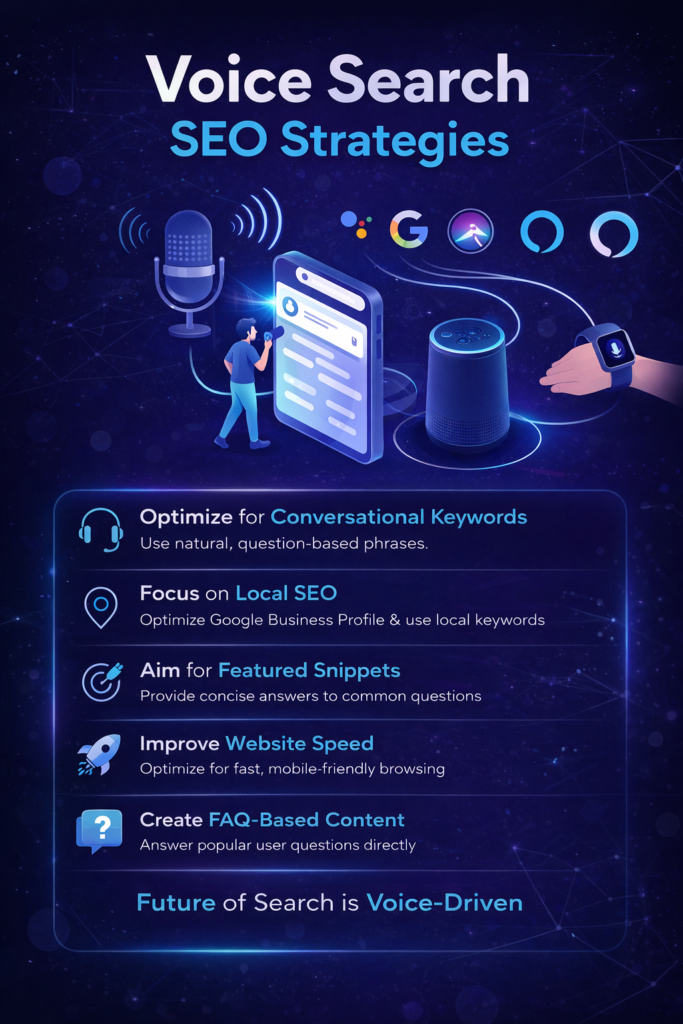
1. Optimize for conversational keywords
Voice searches are longer and more humanlike than text searches. Instead of typing in “Freelance digital marketing expert Thrissur,” you may actually ask, “Who is the best freelance digital marketing expert located in Thrissur?”
To optimize your content for voice search queries, it’s important to use questions within your content, include conversational phrases and natural English sentences, as well as variations on common phrases found in each search context. You can also use tools such as Google’s ‘People Also Ask’ section or AnswerThePublic to identify patterns of how people ask questions about topics related to your business.
2. Focus on local SEO
Voice search is commonly used with location intent, which includes terms like “near me” and “closest to me”. This means you should always update and maintain accurate details on your Google Business Profile, including name, address, telephone number, business hours and ratings/reviews. You can optimize locally by creating and adding content to your profile that references your area’s service area; for example, “Top digital marketing services in Thrissur, Kerala.” You may want to create localized landing pages and implement local schema markup for better ranking in voice search.
3. Aim for featured snippets
Google Featured Snippets act as the primary source for the expansion of Voice Assistant query results or responses and are located at the top of the Google Search results. In order to obtain a Google Featured Snippet position within a search result, you should:
- Use Headings and FAQ Style Q & A Level Headers/Sections
- Provide a Very Short Direct Responding Answer (40-75 words)
- Have Schema Markup for both FAQ-type Questions and How-to Section Markups
This will give your website higher visibility on Voice Assistance devices, and it will also increase your traditional Click Through Rate.
4. Improve website speed and mobile performance
Mobile devices are the primary source for voice search today. A slow or unresponsive site has the potential to harm your rankings? Google favors sites that have a mobile-friendly design and load quickly. You should use tools like PageSpeed Insights and Google Lighthouse to test your site’s speed.
- To ensure that you have fast-loading pages, you should:
- Your pages load in under 3 seconds
- Compress images on your pages
Create a simple, mobile-optimized navigation system
The speed and usability of your pages will directly affect your ability to succeed in voice search.
5. Create content that answers questions
When using voice search, users are typically looking for a specific answer to their question, such as “How can I optimize SEO for My Business?” or “What are good Social Media Marketing Tool Options for Small Businesses?”
This means that you can create content such as Blog Posts, FAQs & Video scripts around these types of user queries.
Users find it to be easier to match their intent to your content when the writing is created with a natural human tone for Google’s NLP Algorithms to process.
The role of AI in voice SEO
Artificial Intelligence is changing the way Voice Search interprets user behaviour. This is done through machine learning methods that allow Search Engines to understand different accents, tones and context. As such, Digital Marketers who take advantage of AI tools to help Predict Keywords, Generate Content and Cluster Queries will have a superior advantage in 2025 and beyond.
The future of voice-driven marketing
As technology continues to grow, voice searches will start to move from being limited to just smartphones and expand into vehicles, wearable devices, and connected appliances. Brands that begin optimizing their content for these new interfaces will gain an edge over their competition in the long term.
Voice search engine optimization (SEO) will evolve into voice commerce (the ability to purchase products via voice command). With this new integration, the gap between merely searching and actually purchasing will shrink completely. As a result, customers will have more rapid decision-making processes and improved personalized experiences.
Conclusion: Adapting to the sound of the future
Search engine optimisation is changing dramatically because of voice search; it’s moving away from traditional keyword based search and towards conversational, contextual, and clear content.
The ability to create SEO-friendly content that reads and sounds human will be essential for brands and marketers as search evolves into spoken searches rather than typed searches.
Contact the best Freelance Digital Marketer in Thrissur